AI and Padel Coaching: How Data Is Revolutionizing Player Improvement in 2026
Artificial intelligence, automatic video analysis, performance tracking: discover how data and AI are transforming padel coaching and accelerating player improvement.
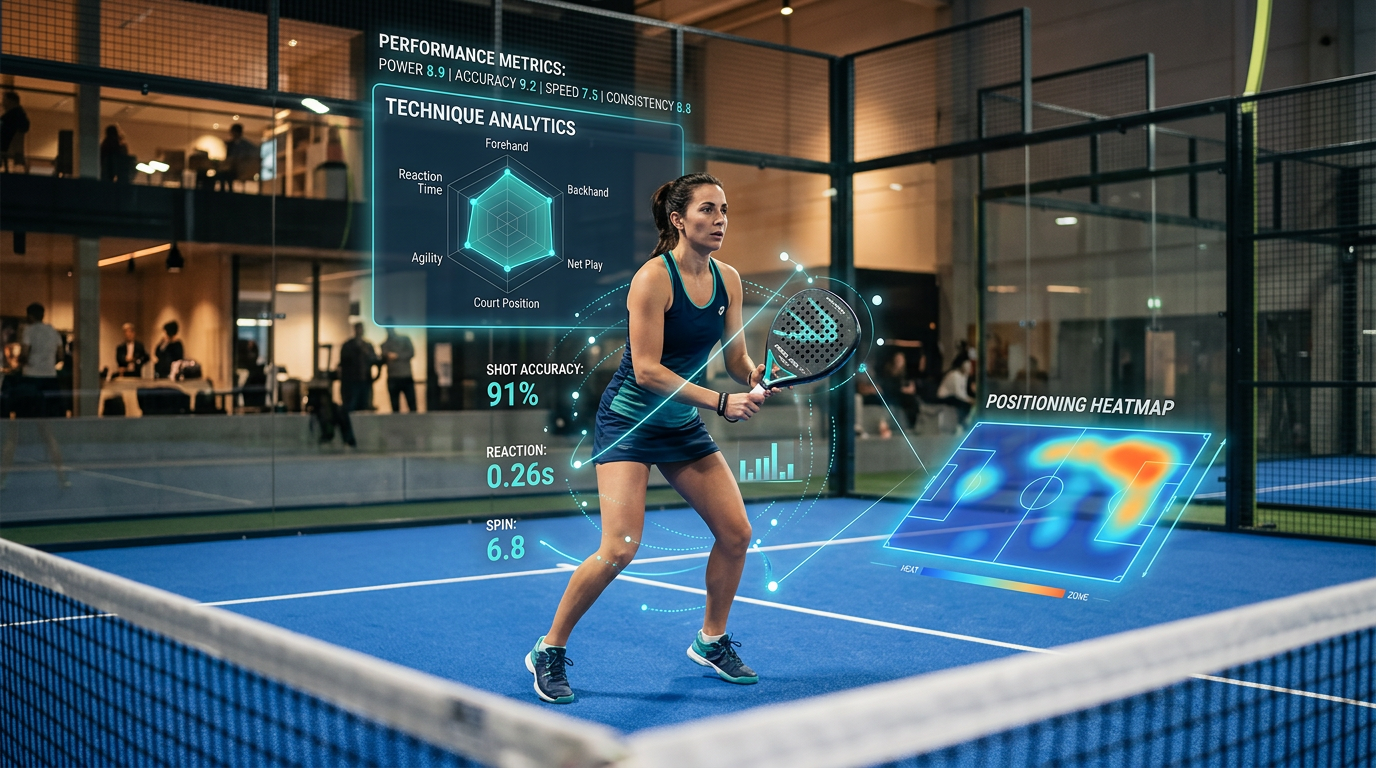
Padel is undergoing a technological revolution. With over 25 million players worldwide and rapid growth across Europe, a new wave of AI-powered tools is transforming how players train and improve. Embedded sensors, automatic video analysis, positioning tracking: data is no longer reserved for World Padel Tour pros.
In 2026, AI and data-driven coaching have been identified as one of the 7 major trends shaping padel's future. This guide explains what these technologies actually do, how to use them, and why they're becoming essential for any player serious about improvement.
1.What AI Actually Changes in Padel
The Traditional Coaching Problem
A coaching session typically lasts 1 hour per week. During that hour, the coach watches, corrects and advises. But what happens during the 3 to 5 other sessions each week? Friendly matches, tournaments, free practice? Nobody is analyzing your game.
The result: most players repeat the same mistakes for months without realizing it. Slow repositioning after a volley, always playing to the same side, poor net-approach timing. These patterns are invisible during a live match.
AI as a Complement to Human Coaching
Artificial intelligence doesn't replace coaches. It complements them by analyzing what the human eye can't cover in real time. Where a coach sees 60 minutes of your game per week, AI can analyze every minute of every match you record.
AI doesn't replace your coach. It provides objective data to make their advice even more precise and personalized. It's an accelerator, not a substitute.
The 4 Pillars of AI Applied to Padel
- Automatic video analysis: AI detects shots, movements and game phases without manual input
- Pattern recognition: identification of recurring tactical patterns, your strengths and weaknesses
- Personalized recommendations: drills and tips tailored to your specific profile, not generic advice
- Progress tracking: objective measurement of your performance over time
2.AI Video Analysis: How It Works
From Smartphone to Full Diagnosis
The process is simpler than you might think. Film your match with a smartphone placed up high behind the court. Upload the video to an analysis platform like PadelIQ. Within minutes, the AI breaks down the footage, identifies players, analyzes shots and generates a detailed report.
Unlike traditional video analysis that requires hours of review, AI does the work in minutes. We've covered the importance of video analysis in depth in our article on padel video analysis.
What AI Detects in Your Game
Dimensions Analyzed Automatically
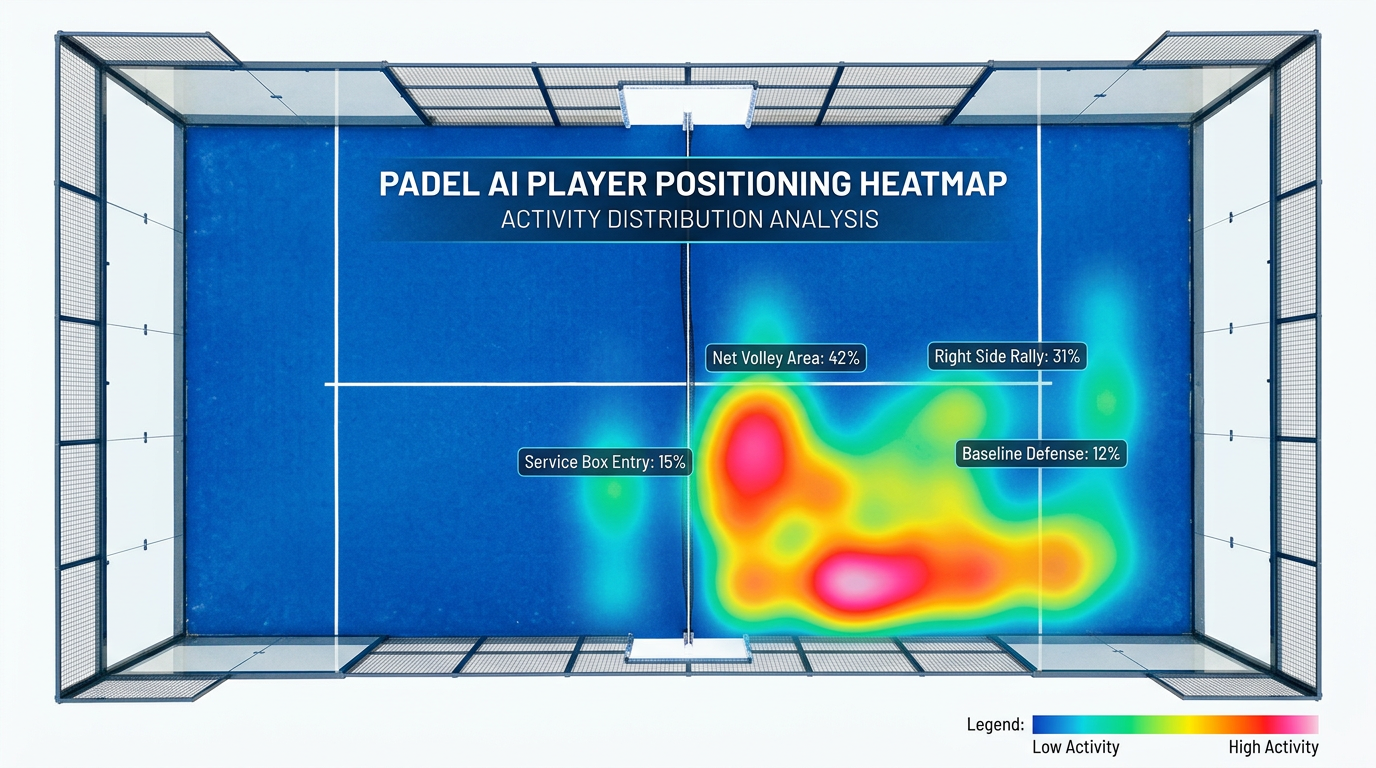
- Positioning: distance from the net, court coverage, defensive and offensive placement
- Shot quality: depth, direction, estimated speed, shot selection based on the situation
- Movement: repositioning speed, lateral coverage, defense-to-attack transitions
- Decision-making: tactical choices, net-approach timing, appropriate shot selection
- Consistency: unforced error rate, performance in long rallies
- Teamwork: partner coordination, communication, zone coverage
The Analysis Report: Your Improvement Roadmap
After each analysis, you receive a structured report. Not just an overall score, but a multi-dimensional diagnosis with actionable recommendations. For example: "Your repositioning after volleys is too slow (1.8 seconds average vs 1.2 seconds for players at your level). Recommended drill: 3-step volley-reposition drill."
This type of precise, data-backed feedback is exactly what 90% of amateur players are missing to improve faster.
Test AI analysis on your next match
Upload your video and receive a complete diagnosis in minutes. First analysis free.
Try for free3.Tracking Technologies in Padel
Racket-Embedded Sensors
Several brands now integrate sensors into their rackets. These devices measure swing speed, impact angle, hitting point on the face and number of shots per session. It's a first level of data, useful for quantifying effort but limited for understanding tactical play.
Positioning Tracking
The most advanced systems use cameras or ground sensors to track all four players' movements in real time. This data enables calculations of distance covered, average speed, zones occupied and transitions between positions.
The Advantage of AI Video Analysis
While sensors provide interesting data, AI video analysis remains the most complete tool because it combines all dimensions from a single source. It sees shots, movements, positioning and tactics. No need for specialized equipment: a smartphone is enough.
4.How Data Accelerates Improvement
Identifying Your Real Weaknesses
The biggest barrier to improvement is not knowing what to work on. Most players have a biased perception of their own game. We remember the missed smash at the crucial point, but forget the 15 poorly handled low volleys that cost just as many points.
Data corrects this bias. It objectively shows where your weaknesses lie, often in areas you hadn't considered. The 15 winning tactical patterns we've identified become much easier to integrate when you know precisely which ones you already use and which ones you're neglecting.
Measuring Progress Over Time
Without data, improvement is a subjective feeling. "I feel like I'm playing better" doesn't compare to "My winning volley percentage went from 42% to 58% in 8 weeks." Objective measurement validates what's working in your training and helps you abandon what isn't producing results.
Personalizing Your Training
A drill is only effective if it targets your actual weakness. Spending 30 minutes on smashes when your real problem is defensive repositioning is wasted time. AI precisely identifies your priority areas and recommends tailored exercises.
Players who combine regular matches with AI analysis experience 2-3x faster improvement on their weak dimensions compared to those who play without structured feedback.
5.Real-World Examples: Data in Action
Case 1: Breaking Through a Plateau
Profile: Julien, P250-level player, plays 3 times a week for 2 years. Stagnating for 6 months despite weekly coaching.
AI Diagnosis: Analysis of his last 4 matches reveals that 68% of his lost points occur after an opponent's lob. His defensive positioning is too far forward: he ends up in "no man's land" on every lob, losing time backing up and hitting off-balance.
Action: By specifically working on back-court repositioning and lob reading for 3 weeks, his lost points on lobs dropped from 68% to 41%.
Case 2: Preparing for a P500 Tournament
Profile: Sarah and Marine, women's team, preparing for a regional P500 tournament.
AI Diagnosis: Team analysis shows an imbalance: Sarah covers 62% of the court while Marine only covers 38%. Long rallies (8+ shots) are lost 73% of the time.
Action: They work on zone distribution and communication. After 4 analyzed matches and targeted adjustments, their win rate on long rallies improves to 51%. They reach the tournament semi-finals.
Case 3: Improving Between Coaching Sessions
Profile: Thomas, beginner for 8 months, takes one lesson per week.
AI Diagnosis: Between lessons, Thomas plays 2 matches per week without feedback. Analysis shows he applies coach's advice during lessons but reverts to old habits in free play (grip too tight, stance too upright).
Action: By reviewing his AI report after each match, Thomas identifies which lesson points he's not applying in matches. He arrives at his next lesson with specific questions, making his coaching sessions twice as productive.
6.Does AI Replace Human Coaches?
What AI Does Better Than Coaches
- Analyze large volumes of data (all your matches, not just one hour per week)
- Detect patterns invisible to the naked eye
- Provide objective, comparative statistics
- Be available 24/7 after every match
What Coaches Do Better Than AI
- Correct technique in real time
- Adapt drills on the fly based on your feeling
- Manage the mental and emotional side
- Build a relationship of trust and motivation
The Winning Combo: Coach + AI
The combination is far more powerful than either alone. The coach uses AI data to prepare sessions. AI extends the coach's work between lessons. The player improves faster with continuous, personalized feedback. It's the same approach professional tennis has used for years, with data analysts working alongside coaches.
💡The best investment for your game: a coach for fundamentals + AI for continuous tracking. That's the recipe players who improve fastest follow.
7.How to Get Started with AI Analysis
Step 1: Film Your Match
Place a smartphone or camera up high behind the court (fence posts work great). Film in landscape mode, capturing the entire court. No professional equipment needed.
Step 2: Upload and Analyze
Send your video to PadelIQ. The AI automatically analyzes your match and generates a report within minutes.
Step 3: Read and Apply Recommendations
Focus on the 2-3 priority areas identified. Don't try to fix everything at once. The classic mistake is working on 10 things simultaneously. For more tips on how to improve at padel, our complete guide details the step-by-step structured approach.
Step 4: Repeat and Measure
Run another analysis every 2-4 weeks to track your progress. Improvement shows in the numbers, match after match. Check our pricing to choose the plan that fits your playing frequency.
Don't fall into the over-analysis trap. The goal isn't to measure everything, but to turn data into concrete actions on the court. 2 focus areas per month is enough to improve rapidly.
8.The Future of Padel Coaching: What's Coming in 2026-2027
Real-Time Analysis
The next breakthroughs are in live feedback during matches. Imagine receiving a tactical summary between sets, with your opponents' tendencies and adjustment suggestions. Computer vision technology is advancing fast enough for this to become reality within 12-18 months.
Connected Clubs
Premium clubs are increasingly integrating technology: fixed cameras on every court, automatic tracking systems, debriefing screens courtside. Padel is following the same trajectory as golf with launch monitors or tennis with Hawk-Eye.
Full Democratization
What was reserved for professional players 5 years ago is now accessible to anyone with a smartphone. This trend will accelerate with faster, more accurate and more affordable analyses. Visit our FAQ to learn how PadelIQ fits into this revolution.
9.Frequently Asked Questions
Can AI really replace a padel coach? No, and that's not the goal. AI excels at data analysis and pattern detection, but human coaches remain irreplaceable for real-time technical correction, mental management and the trust relationship. The coach + AI combination is the most effective formula for improvement.
Do I need special equipment to use AI analysis in padel? A simple smartphone is all you need. Place it high up behind the court, film in landscape mode and upload the video to PadelIQ. No professional camera, racket sensor or fixed installation required.
How many matches do I need to analyze to see results? The first analysis already provides useful insights. But comparing 3-4 analyses over 4-8 weeks is when progress becomes truly measurable. Ideally, analyze one match every 2 weeks for consistent tracking.
10.Ready to Enter the Era of Intelligent Coaching?
Upload your first match video to PadelIQ and discover what AI reveals about your game. Multi-dimensional diagnosis, personalized recommendations and progress tracking: everything you need to level up.
1st analysis free, no credit card required