Tactical Padel Analysis: 15 Patterns to Win More Matches
Padel tactics and winning patterns: discover 15 game patterns used by pros. Video analysis helps you identify them and integrate them into your game.
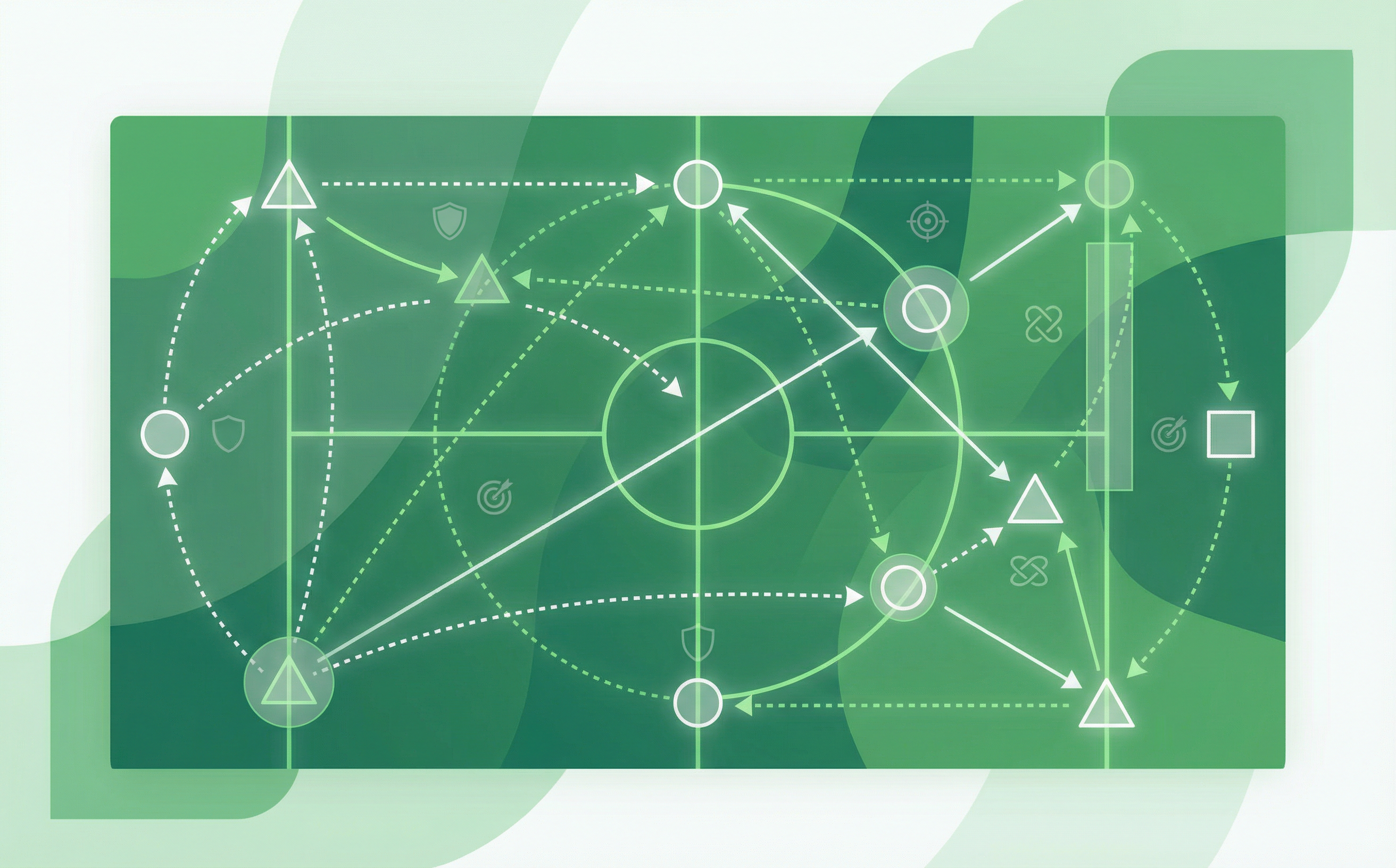
Winning at padel is not just about power or technique. Players who string together victories master tactical patterns: sequences of shots and placements that repeat and create the advantage. The French Tennis Federation and World Padel Tour show it: at the highest level, reading the game and applying proven patterns make the difference. In this guide we detail 15 tactical patterns you can integrate into your game, from the cross-court lob to the centre bandeja and wrong-footing. To improve tactically, our article how to improve at padel lays the foundations; padel video analysis helps you spot which of these patterns you already use and which you neglect.
It is better to master 4 or 5 patterns perfectly and use them at the right moment than to try to play everything without consistency. Choose two or three to work on first according to your level and your matches.
Let's start with the first pattern.
1.1. The cross-court lob to retake the net
The cross-court lob sends the ball high and diagonally from the back of the court so that it lands in the opponent's service box on the diagonal. It is one of the most useful patterns for retaking the net when you are on the defensive.
When to use it: When your opponents are well set at the net and you receive a playable ball at the back of the court. The cross-court lob forces them to move back and play a high ball, which gives you time to move up and align with your partner.
Tip: Aim for depth rather than the baseline. A lob that lands 1 or 2 metres from the back wall is already very effective. In training, work in pairs: one player sends short balls, the other systematically replies with a cross-court lob then moves up. Repeat the sequence until the move-up becomes automatic. To refine your reading of the game, video analysis of your matches lets you check whether you move up properly after your lobs or stay back.
2.2. The centre bandeja to reduce angles
The centre bandeja is a defensive or transition shot played above head height that sends the ball towards the centre of the opponent's court. It reduces attack angles and forces the opponent to play a more neutral ball.
When to use it: When you are under pressure at the net, the ball arrives at shoulder height or above and you cannot attack cleanly. A centre bandeja lets you hold the net without taking unnecessary risk.
Tip: The key is your partner's positioning: you should play the bandeja so the ball goes between the two opponents or towards the more uncomfortable player. A simple drill: in a two-on-two exercise, require yourself to play three centre bandejas in a row before allowing an acceleration. You will quickly see how much this pattern secures the point. The best players on the pro circuit use this pattern repeatedly to build the point, as you can see on the World Padel Tour. If you are new to the bandeja, our article on common padel mistakes will help you avoid preparation or stroke errors.
3.3. Wrong-footing to surprise the opponent
Wrong-footing means sending the ball to the side opposite to where the opponent is moving or expects it. In padel it is often used in volley or off the back glass to open the court or finish the point.
When to use it: When the opponent has started to move (for example towards the centre after a previous ball to the centre) or when they are off balance. Wrong-footing exploits their momentum and creates open space.
Tip: Do not overuse it. If you wrong-foot on every ball, the opponent will anticipate it. Alternate with balls to the centre and balls in the expected direction. In training, work the sequence: one ball to the centre, one wrong-foot. Video is ideal to check if you pick the right moment: match analysis can highlight points where a wrong-foot would have paid off.
4.4. Moving up to the net after a lob
This pattern is moving up to the net as soon as you have played an effective lob (deep and high), coordinating with your partner so you both reach the net together.
When to use it: After any lob that forces the opponent to play a high ball from the back (defensive smash, bandeja or other). That is when the balance of power shifts: if you stay back, you lose the advantage of the lob.
Tip: Move up diagonally towards your side of the court, not straight at the net. That way you cover the line and avoid leaving an open corridor. Practise in situation: one player sends a lob, both move up immediately and play the next ball at the net. Repeat with different lob qualities (short, long, cross, parallel) to adapt to all situations. For more on overall tactics, the guide how to improve at padel details the role of moving up to the net in your strategy.
5.5. The cross-court smash to finish the point
The cross-court smash is an offensive shot that sends the ball diagonally from your side to the opposite side. It is harder to defend than a down-the-line smash because it uses the full court and pushes the defender away from the centre.
When to use it: When you have a high ball at the net, the opponent is at the back or retreating, and you want to finish the point. The cross increases the angle and reduces the chances of a comeback.
Tip: Aim for the area between the opponent and the side glass, not the glass itself. A smash that bounces in the cross-court corridor is often unreturnable. In training, work on accuracy at 70% power first: a well-placed cross-court smash is more effective than a full 100% smash to the centre. See our FAQ for tips on training with PadelIQ.
6.6. Low balls to the centre to play safe
Playing low and to the centre means sending balls that pass low over the net and target the central zone of the opponent's court. This pattern limits errors and gives the opponent few angles.
When to use it: In stressful situations (close score, important point), when you want to regain control of the rally or when your opponents are attacking and you need to make them play one more ball. Low balls to the centre are the foundation of solid play.
Tip: Prioritise consistency over risk. In training, play rallies where the only instruction is "low ball, centre". Count the number of rallies without an error. Video analysis often shows that points are lost on balls that are too high or too wide; this pattern corrects those tendencies.
7.7. The back glass for defence and recovery
Using the back glass in defence means letting the ball bounce on the back wall before hitting it. This gives you time and allows you to return a high ball (lob) or a bandeja to retake the net.
When to use it: When you are late on the ball, when the opponent's lob is deep or when you want to break the rhythm of the attack. The back glass is a pillar of defensive play in padel.
Tip: Do not stay stuck to the wall. Step back to let the ball bounce, then step forward to hit; this repositions you for the next ball. In training, do sets of 10 balls: your partner sends lobs, you systematically play the back glass exit then a lob. This pattern is so central that it is among the fundamentals taught in FFT training programmes. Once the glass exit is mastered, follow with a move up to the net (pattern 4) to regain the advantage.
8.8. The chiquita to unsettle
The chiquita is a short shot, often played as a volley or half-volley, that sends the ball just over the net with little height. It forces the opponent to come in and play a difficult ball.
When to use it: When your opponents are at the back of the court or when one of them has just moved back after a lob. A well-placed chiquita (side or centre) forces them to run in and play upwards.
Tip: Vary the placement: sometimes to the centre, sometimes into the corridor to open the court. The chiquita should not be predictable. In training, work on accuracy: aim for a one-square-metre zone behind the net. Research in sport science on tactical variety shows that players who alternate short and long win more points than those who always play the same depth.
9.9. The approach volley to the feet
The volley to the feet directs the volley towards the opponent's feet (often the net player) rather than into open space. This disrupts their stroke and reduces their options.
When to use it: When you are at the net and receive a playable ball but not high enough to attack. A feet volley prevents the opponent from moving up comfortably and keeps you in a dominant position.
Tip: Aim at the feet or legs, not the body. A ball at the feet is harder to control than a ball at waist height. In training, in cross volley situations, set yourself a minimum number of "feet" volleys per rally. Then vary the placement (left player's feet, right player's feet, centre) to be unpredictable. This pattern is one that PadelIQ video analysis can help you quantify: do you use the feet volley enough?
10.10. Down-the-line play to open the court
Down-the-line play means sending the ball on the same side of the court it came from (long line), rather than cross-court. It serves to open the court: after several down-the-line balls, a cross-court ball finds more space.
When to use it: When you are building the point and want to create an angle. String two or three down-the-line balls to move the opponents, then play the cross-court ball to finish or unbalance them.
Tip: Down-the-line play requires consistency. If you make an error down the line, you will not get the chance to play the cross-court ball. In training, work the sequence: down the line, down the line, cross. Gradually increase the pace to get closer to match conditions. For more on point construction, see our article on common padel mistakes, which includes overusing the centre at the expense of down-the-line play.
11.11. The vibora to accelerate with control
The vibora is an offensive shot played above head height, between the bandeja and the smash, with sidespin. It allows you to accelerate while keeping a safety margin compared to a full smash.
When to use it: When the ball is at shoulder height or a bit higher, you are at the net and you want to take the initiative without going all-in on a smash. The vibora can be played cross-court or down the line to open the court.
Tip: The key is wrist placement and hitting forward-down, not just down. In training, alternate bandeja and vibora on medium-height balls: the bandeja secures, the vibora accelerates. Work on cross-court and down-the-line vibora so you have both options in a match. Analysis of your matches can show whether you overuse the vibora (and make errors) or do not use it enough.
12.12. The down-the-line lob to keep the opponent at the back
The down-the-line lob sends the ball high on the same side of the court (parallel), towards the back of the opponent's court. It is harder to intercept than a cross-court lob because it goes towards the corridor.
When to use it: When the net player on that side tends to cut cross-court lobs, or when you want to keep a precise opponent at the back. The down-the-line lob pins them at the back and gives you time to move up.
Tip: It requires more accuracy than the cross-court lob because the court is shorter in length. Aim for the baseline without going past it. In training, work the down-the-line lob from both the left and right halves of the court so you are comfortable on both sides. This pattern is widely used on the World Padel Tour to handle pressure.
13.13. Lining up with your partner
This tactical pattern is not about a single shot but movement: you and your partner reposition together, in a line parallel to the net, after each exchange. That way you cover the court consistently and avoid gaps.
When to use it: All the time. Lining up is the basis of doubles. As soon as the ball changes side or height, both players move to stay aligned (slightly offset depending on the ball position).
Tip: Communicate: "Yours", "Mine" on balls to the centre. In training, film a rally and watch afterwards whether you were in line at each shot. Correct any misalignment: one player too far forward or back relative to the other creates spaces the opponent can exploit. Video analysis is especially useful for assessing your positioning, a factor often overlooked by amateur players.
14.14. The ball to the feet to block the move-up
Sending the ball to the feet of the opponent (often when they are about to move up to the net) blocks their momentum and forces them to play an upward ball, which is attackable.
When to use it: When the opponent is in transition (moving forward to come to the net) or when they are already at the net but slightly back. A low ball to the feet is very uncomfortable to play.
Tip: Use a low volley or a flat ball from the back. In training, work on accuracy: aim for a zone one metre in front of your partner's feet. When they are at the net, try to send the ball just in front of their stance so they have to play on the rise. This pattern complements the feet volley (pattern 9): one is played at the net, the other from the back or in transition. For a reminder of the basics, see how to improve at padel.
15.15. Alternating lob and acceleration to vary the rhythm
This pattern is alternating high, slow balls (lobs) with accelerations (aggressive volleys, viboras, smashes). The change of pace unsettles the opponent and creates openings.
When to use it: When the rally is neutral and you want to take the initiative. After one or two lobs, the opponent expects another high ball; an acceleration at the right moment is often decisive.
Tip: Do not rush the acceleration. First build with safe balls (lobs, centre bandejas), then accelerate on a slightly shorter or slightly higher ball. In training, set yourself the sequence: lob, lob, acceleration. Analysis of your matches can reveal whether you vary the rhythm enough or play too predictably; see our pricing for regular analyses.
Identify your tactical patterns on video
PadelIQ analyses your matches and shows you which patterns you use or neglect, with personalised advice.
Try for free16.Analyzing These Patterns on Video
Knowing the 15 patterns is not enough: you need to recognise them in your own game and spot the ones you underuse. That is where video analysis becomes essential. By watching your matches you can count how often you move up to the net after a lob, how many centre bandejas you play, or whether you alternate lob and acceleration enough. Without video, these tendencies stay invisible: we all have a biased picture of our game in real situations.
PadelIQ automates this work: the AI analyses your videos and highlights your tactical habits, strengths and the patterns to prioritise. You get targeted recommendations and exercises suited to your level. Ideally, do two or three analyses over a few weeks to see which patterns improve and which still need to be integrated. To go deeper into the method, read our article on padel video analysis. You can start with a first free analysis on sign-up and check our pricing for regular follow-up.
17.Frequently Asked Questions
What are the most important tactical patterns for an intermediate player? The most rewarding are the cross-court lob to retake the net, the centre bandeja to reduce angles, low balls to the centre to play safe, and lining up with your partner. Mastering these four patterns already improves consistency and point construction. Video analysis helps you see which you already apply and which to work on first.
How can I train tactical patterns without a partner? You can work on stroke technique (lob, bandeja, feet volley) on your own against a wall or with a ball machine if you have one. For situational patterns (moving up after a lob, alternating lob and acceleration), you need at least one partner. Video analysis complements training by identifying which patterns to integrate in matches. Our FAQ details how to use PadelIQ to focus on tactics.
Does video analysis really help improve padel tactics? Yes. Video reveals patterns you do not notice while playing: for example a tendency not to move up after a lob or to always play to the centre. Once these habits are identified, you can correct them in training and in matches. PadelIQ users who combine regular analysis with focused work on 2 or 3 patterns generally see faster progress. Discover how to improve at padel with a structured approach.
18.Ready to take action?
Move from theory to practice: upload a match video on PadelIQ and discover which patterns you use most, which you neglect and how to integrate them into your game. First analysis free, no commitment.