Padel Rankings France vs Spain vs USA: The Ultimate Guide to Understanding Your Level Worldwide
Padel rankings France, Spain, USA: decode the 3 systems (FFT, FEP, World Padel Rating) and compare your level worldwide with our equivalence table.
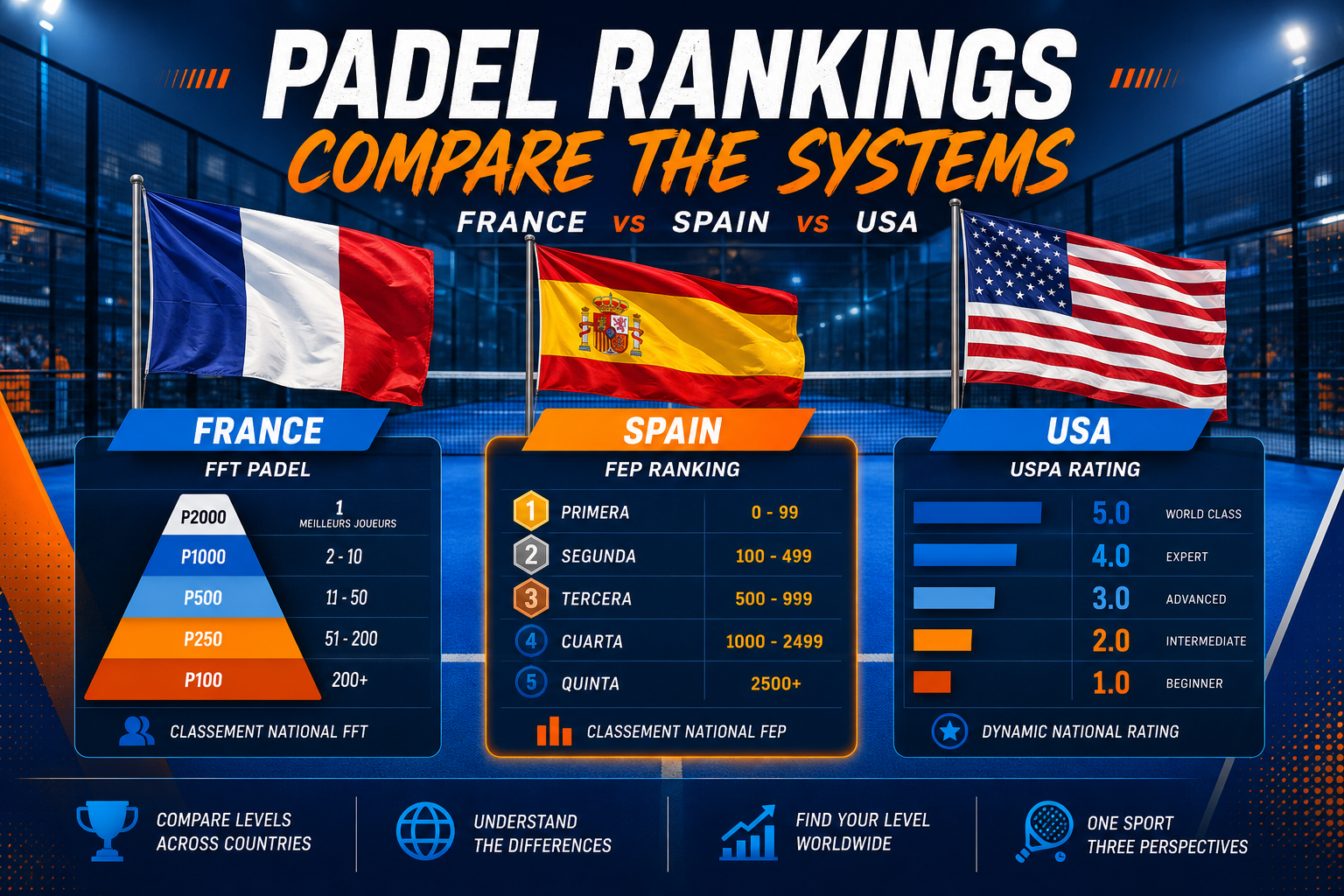
You're heading to Marbella for the weekend, walk into a Spanish club, and someone asks with a smile: "¿Qué categoría juegas?" What do you say? "Uh… P500 in France?" Awkward silence.
Padel has become a global sport with over 35 million players across 140 countries, but each federation has invented its own language to measure skill level. The result: a Top 1000 French player, a 3ª categoría Spanish player, and a 13-rated World Padel Rating American player can have exactly the same actual level… without knowing it.
In this guide, we decode the 3 major global systems (France, Spain, USA), explain the FIP ranking for pros, and give you an equivalence table so you'll never get caught off guard during a padel trip again.
1.The French system: FFT and rolling points
In France, the French Tennis Federation (FFT) manages padel. The system is numerical: each licensed player receives a ranking (from NC to top 10) based on tournament results.
How does it work exactly?
- Your 10 best results over the last 12 months count (rolling ranking).
- Monthly update, on the first Tuesday of each month.
- The higher the tournament in the pyramid, the more points it awards.
The French tournament pyramid
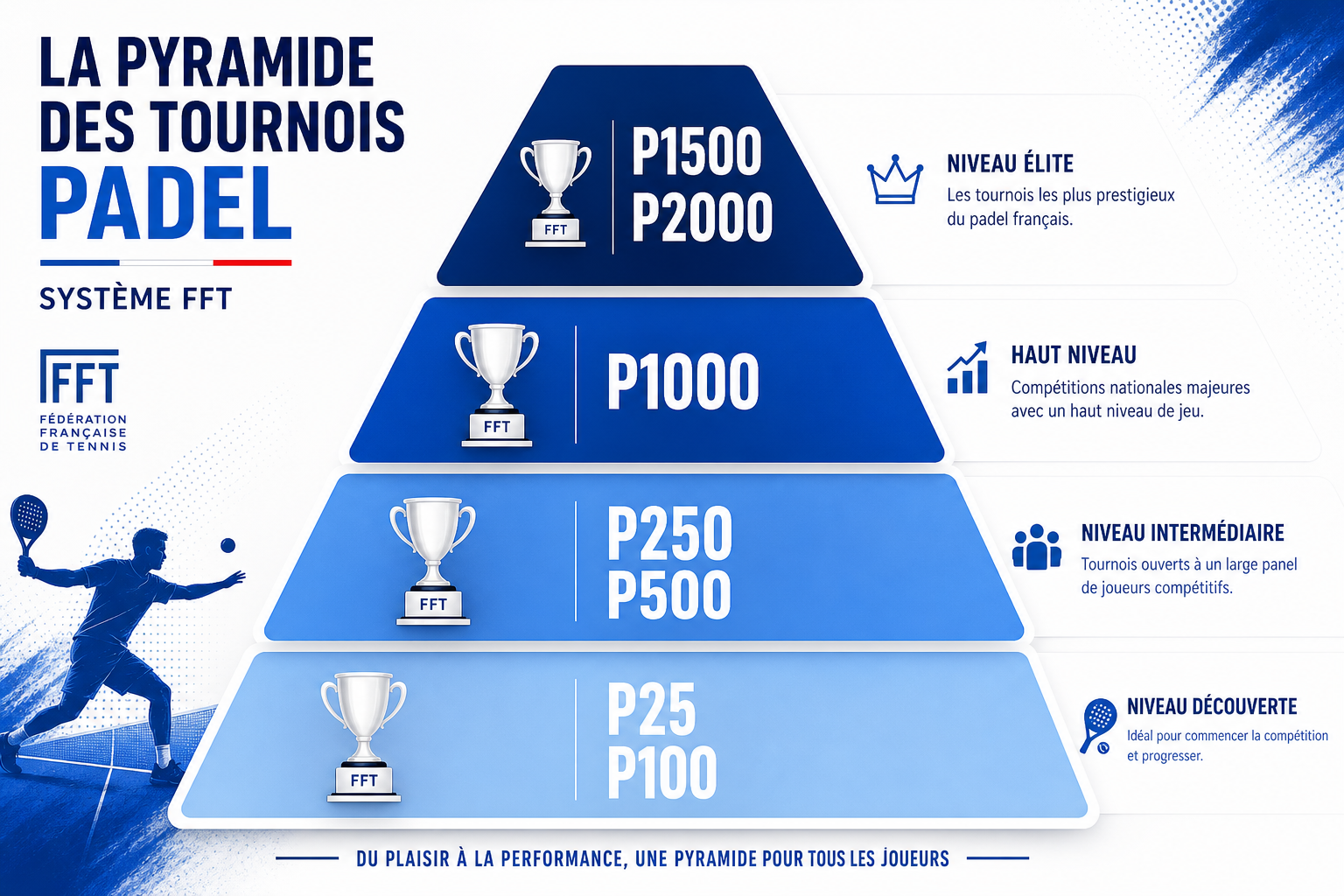
The French system is based on a tournament hierarchy:
| Tournament | Typical level | |---------|-------------| | P25 / P100 | Recreational, beginners to intermediate | | P250 / P500 | Confirmed competitors | | P1000 | Very good regional level | | P1500 / P2000 | National elite |
The 8-level grid: the real club reference
Alongside the official ranking, French Padel Shop x Padel Magazine created an 8-level grid that has become the reference in France for organizing club-level groups. Here are the key milestones:
- Level 4 — Intermediate: you can sustain long rallies, starting to play with the glass, bottom of P100 draw (5 to 25 points per tournament).
- Level 5 — Confirmed: Top 10,000 men / Top 1,500 women, middle of P100 draw.
- Level 6 — Advanced: Top 6,000 men / Top 900 women, regularly playing P250.
- Level 8 — Elite: Top 1,000 men / Top 150 women, competing in P1000 to P2000.
A single French tournament mixes players of different rankings. The draw balances itself, not the tournament entry.
2.The Spanish system: FEP and categorías
In Spain, padel has been a cult sport since 1974. With over 15,300 courts, around 5 million players, and a court installed at Lionel Messi's home in Castelldefels, the country is simply the world capital of this sport.
It makes sense that the Federación Española de Pádel (FEP) has a more structured system than ours.
The Ranking Único and categorías
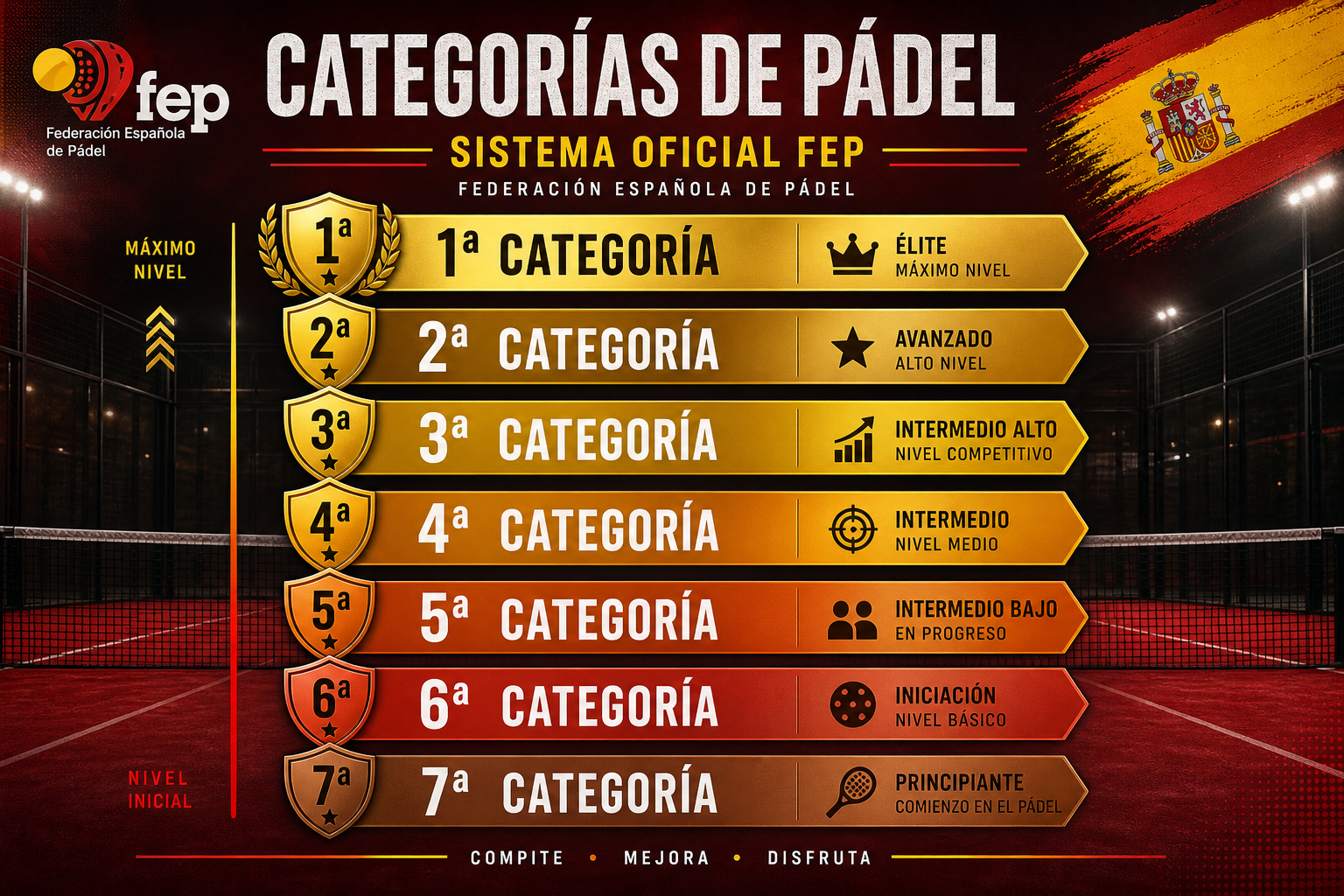
The FEP manages a Ranking Único (single ranking) based on all approved national and regional tournaments. But more importantly, it organizes competitions by closed categories:
- 1ª categoría: national elite (equivalent to Top 100 French)
- 2ª categoría: very good level, serious competitors
- 3ª categoría: good amateur competitors
- 4ª to 7ª categoría: intermediate to beginners
The big difference from France
In Spain, a tournament is open to ONE single categoría. You only play against players of your level. In France, everyone registers for the same tournament and the draw then manages the skill gaps.
Calculate your real padel level
PadelIQ analyzes your game and gives you your equivalence in the 3 global systems.
Try for freeSpanish game is not French game
One essential clarification: a Spanish player ranked 4ª categoría plays differently from a French player of equivalent level. The Iberian game is defensive, patient, focused on consistency, while French play often favors power and spectacular winning shots. At equal level, the Spaniard will make fewer unforced errors. You've been warned.
3.The American system: USPA + World Padel Rating
In the United States, padel has been exploding since 2022. A young market, but one that skipped the "old-school system" phase to directly adopt the dynamic rating philosophy, similar to DUPR in pickleball.
The World Padel Rating (WPR)
Since 2024, the United States Padel Association (USPA) has adopted the World Padel Rating (formerly RedPADEL Rating) as its official system.
- Scale from 0 to 21: 0 = discovering the sport, 21 = world-class.
- Weekly update (every Wednesday).
- Each rating comes with a "confidence index": the more you play, the more accurate your number.
- All Nox USPA Circuit competitions count toward your rating.
USPA tournament selection
To participate in major events (like the P1 Las Vegas Open), the USPA combines 3 criteria:
- Your FIP ranking (Top 300 worldwide)
- Your USPA national ranking
- Your personal World Padel Rating
The clever thing about WPR: unlike France where you can "collect" points from small tournaments, here your rating reflects your real average level over your recent matches. Fairer, more dynamic.
4.And what about the world ranking? The FIP Ranking
To follow the pros (Tapia, Coello, Galán, Lebrón, Augsburger…), there is one official ranking: the FIP Ranking managed by the International Padel Federation.
How it works
- Counts your 22 best results on the Qatar Airways Premier Padel and CUPRA FIP Tour circuits over a rolling 52-week period.
- "Defence points" system: to keep your points, you must match your performance during the same week the following year. Otherwise they expire.
- In parallel, the "Race" measures your best results over the current calendar year.
Why do Tapia and Coello have different points?
Many fans ask: they play together, how can they be at different ranking positions? Simple answer: FIP points are individual, not awarded to the pair. If one had made a final six months earlier with another partner, he kept those points. That's also why Augsburger overtook Coello for 2nd place worldwide in 2026 after his big results with Lebrón.
5.The equivalence table between the 3 systems
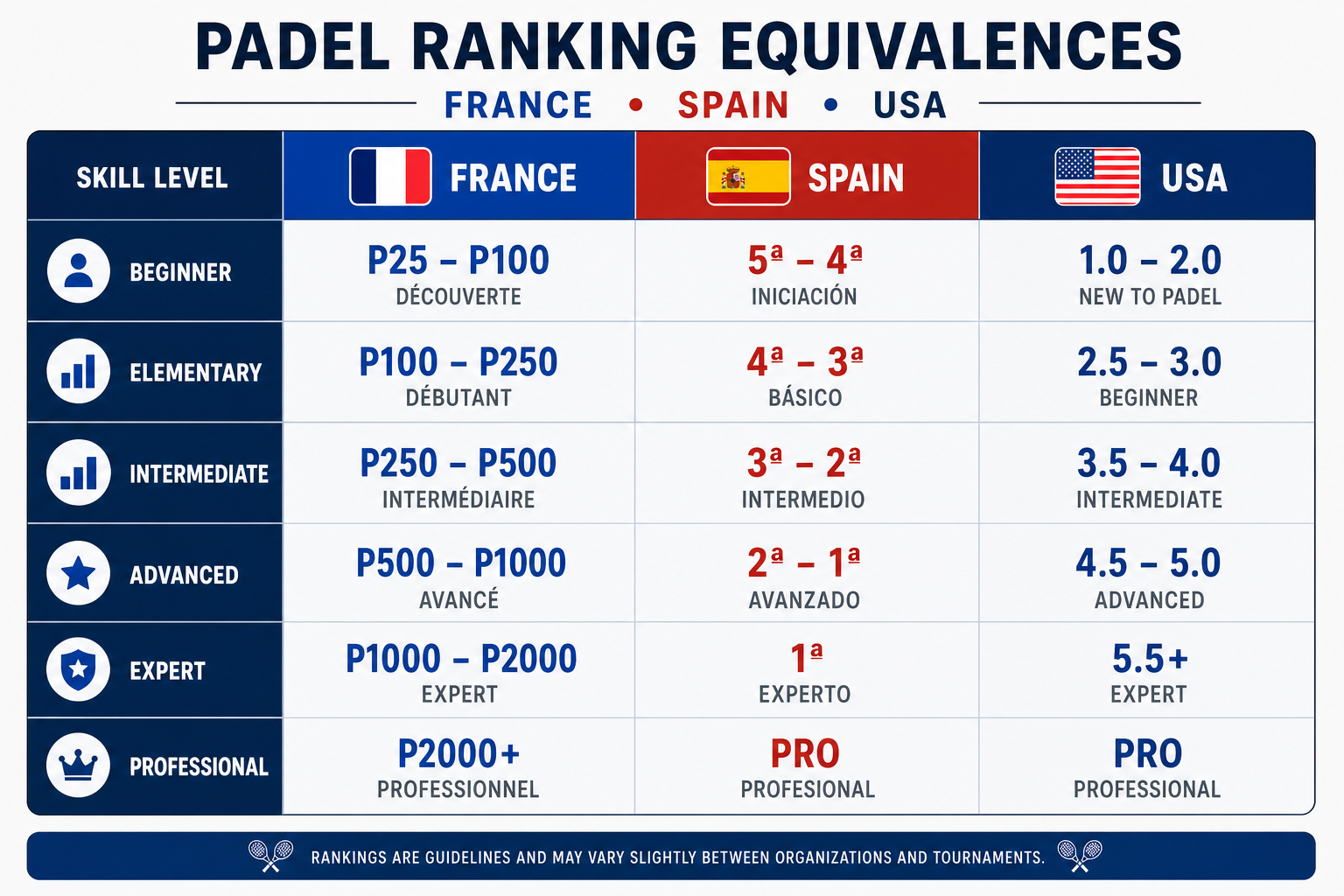
Here's THE table you're looking for. Bookmark it before your next padel trip.
| Real level | France (FFT) | Spain (FEP) | USA (WPR) | |---|---|---|---| | Total beginner | NC | 7ª categoría | 0–3 | | Recreational | Top 15,000+ | 6ª categoría | 4–6 | | Confirmed recreational | Top 6,000–10,000 | 5ª categoría | 7–9 | | Good competitor | Top 1,500–6,000 | 4ª categoría | 10–12 | | Very good level | Top 500–1,500 | 3ª categoría | 13–15 | | National competitor | Top 100–500 | 2ª categoría | 16–18 | | Elite / Pro | Top 100 | 1ª categoría | 19–21 |
These equivalences are indicative, not official. A Top 1000 French player heading to Andalusia will often be overclassified: the depth of the Spanish pool means that at "equivalent" ranking, the Spaniard often has 2 more years of practice.
6.Why do these differences exist?
Three major factors explain the gap between these systems:
- Market maturity: 50 years in Spain, 15 years in France, 5 years in USA.
- Player density: ~5M in Spain, ~500,000 in France, ~100,000 in USA (but with triple-digit growth).
- Sports philosophy: tournament pyramid (FR), closed categories (ESP), dynamic rating (USA).
Each system reflects where the country is in its padel development. France still follows a model inherited from tennis; Spain has its own mature ecosystem; the United States is innovating from scratch with the best data tools. To better understand how to improve in these different systems, check out our complete guide to improve at padel.
7.Frequently Asked Questions
Can a French P1000 player compete in Spanish 2ª categoría? On paper yes, the level is close. But in practice, prepare for a shock: 2ª categoría in Spain is a very demanding technical level. Aim for 3ª categoría for your first tournament there, especially if you're playing in a big city like Madrid or Barcelona.
How do I convert my FFT ranking to World Padel Rating? There is no official conversion between FFT and WPR. The table above is the best indicative equivalence. To get a real WPR, you need to play USPA-sanctioned tournaments in the United States or via the World Padel Rating platform.
Which is the fairest system to evaluate skill level? Each system has its qualities. The American WPR is probably the most individually accurate (weekly update + confidence index), but you need to play a lot for it to be reliable. The French system rewards consistency in competition. The Spanish system guarantees you'll always play against players of your level.
8.Ready to take action?
Knowing your real level is the starting point for choosing the right training partners, registering for the right tournament, and tracking your progress objectively. Whether you play in France, Spain, or the United States, PadelIQ analyzes your game and gives you your equivalence in the 3 global systems.
First analysis free, no credit card required