Indoor padel: why decision-making now matters more than technique
Indoor padel speeds up the game and exposes tactical weaknesses. Learn why decision-making has become the key skill to improve, and how to adapt your training.
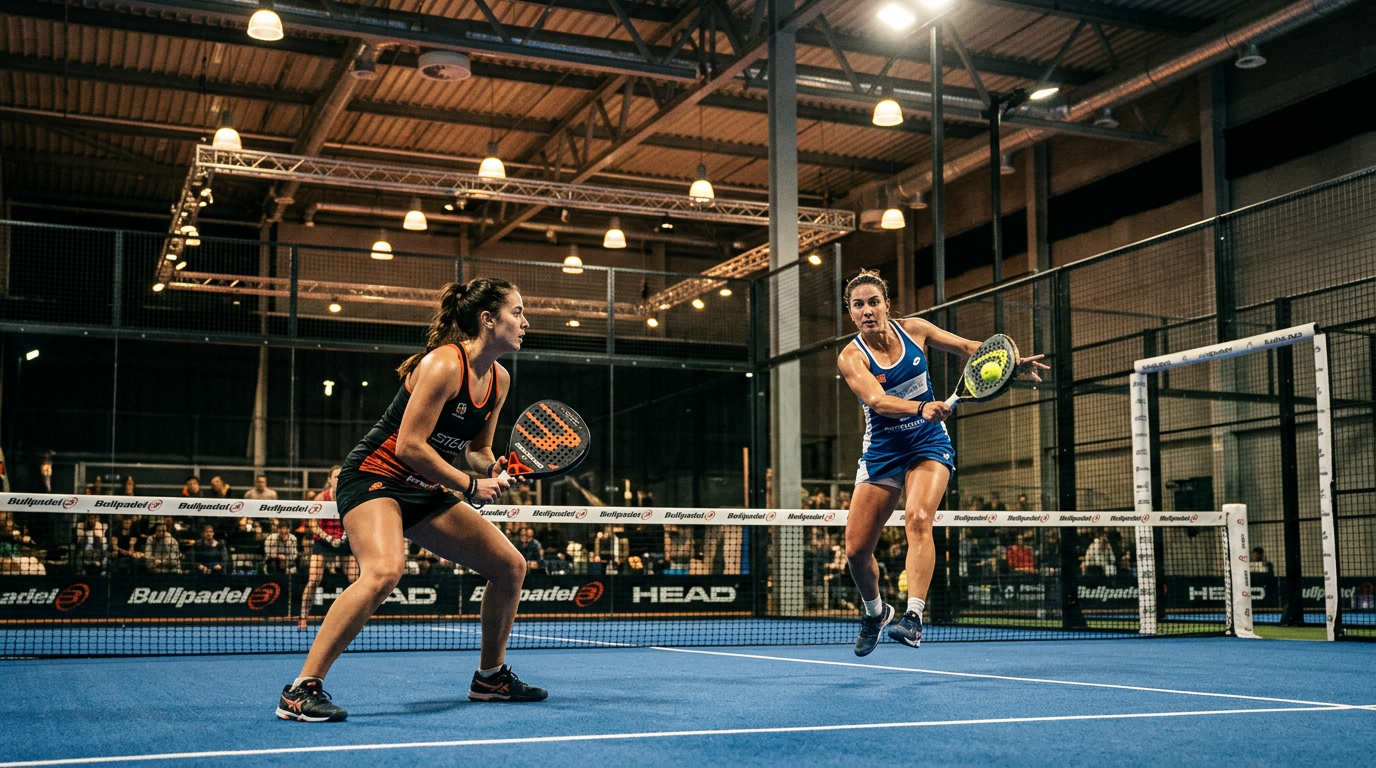
Over the past few months, a quiet shift has been taking place in professional padel. More and more tournaments are being played indoors. Less wind, less randomness, perfectly controlled conditions. The game is getting faster, more readable, and above all, far more demanding.
Padel is no longer just a sport of technique. It has become a sport of decisions. And that is exactly where most players, even good ones, start falling behind.
In this article, we break down what is really changing with the move to indoor padel, and why your current training approach is probably no longer enough.
1.A faster game that gives you less time to think
Conditions that change everything
Indoor play removes almost every external variable:
- No wind to alter ball trajectories
- Consistent bounces off the glass walls
- Predictable ball flight from one point to the next
The consequence is immediate: rallies speed up. Pro players have more control, so they take more risks, and the pace increases naturally. You can see it clearly on the World Padel Tour: indoor points are shorter and more intense on average.
Less randomness, more accountability
In outdoor padel, you could "blame" certain situations. A misjudged lob because of the sun. A missed smash because of a gust of wind. Natural excuses that softened the impact of mistakes.
Indoors, those excuses disappear.
Every point becomes readable. Every mistake becomes a mistake of choice, not a mistake of circumstance. There is nowhere to hide behind external conditions.
Timing becomes the key skill
This is the deepest change. In indoor padel, thinking time shrinks. You need to decide earlier:
- Play or wait for the ball to come off the glass
- Speed up or slow down the rally pace
- Move to the net or hold back at the baseline
The best player is no longer the one who hits the hardest. It is the one who chooses fast and right. This concept of rapid decision-making is widely studied in sports science.
In indoor padel, the average time between shots drops significantly. Your brain needs to process information and decide faster than outdoors. It is as much a mental workout as a physical one.
2.Why most players are stuck today
Training methods stuck in the past
Most players still train the same way:
- Shot repetition in static drills
- Pure technique work: bandeja, vibora, volleys
- Dominant mindset: "I need to hit the ball better"
That is not wrong. Technique remains an essential foundation (we cover this in detail in our complete guide to improving at padel). But it is no longer enough to break through to the next level.
A huge gap between training and match reality
Training sessions are clean. Matches are chaotic.
In a match, you constantly need to:
- Read the opponents' positioning
- Anticipate the next shot
- Adapt to the playing style across the net
And this reading ability is almost never practised in training. The result is a gap between how good you feel in practice and how you actually perform in competition.
The false sense of progress
You improve in training. You feel more comfortable with your shots. But in matches:
- You make the same mistakes
- You lose the same types of points
- You get stuck in the same situations
Why? Because you improved your shots, not your decisions. This is one of the most common mistakes in padel: confusing technical progress with overall progress.
Identify your real areas for improvement
PadelIQ uses AI to analyse your matches and reveal the tactical patterns you cannot see with the naked eye.
Analyse my game for free3.The real gap: it is not technique, it is decision-making
What actually wins points today
At the same technical level, the difference comes down to four dimensions:
- Zone selection: playing to the right spot at the right time
- Timing: accelerating or slowing down based on the situation
- Game reading: anticipating the opponents' intentions
- Adaptation: adjusting your plan mid-point
It is not the quality of the stroke that separates two players of equal level. It is the quality of their choices.
The most frequent match errors
We all know them. But we keep repeating them:
- Attacking at the wrong moment: going for a smash on a ball that is not high enough
- Accelerating without reason: forcing the pace when the rally is neutral
- Poor positioning: being too far from or too close to the net
- Playing too fast or too slow: failing to match the rhythm of the point
These are not technical errors. They are reading errors. And they cost far more in indoor padel, where every mistake is immediately exploited.
A different way to improve: understanding instead of repeating
The real lever for improvement is here:
- Analyse your points after every match
- Understand why you lose certain types of rallies
- Identify recurring patterns in your mistakes
- Correct your choices rather than your strokes
It is less glamorous than working on your smashes. But it is far more effective for winning matches. Video analysis in padel is one of the best tools for this work.
4.Padel IQ: the new skill to develop
What it means in practice
Your "padel IQ" is your ability to:
- Read the game in real time
- Anticipate situations before they unfold
- Choose the right option at the right moment
It is an invisible skill. You will not see it in a highlights reel. But it is what separates a player who wins points from a player who wins matches.
Why indoor padel exposes it even more
Fewer external variables means more pressure on your decisions. In indoor padel:
- Mistakes are immediately visible: no excuses related to conditions
- Bad choices cost more: the pace does not forgive
- Good players exploit everything: every hesitation is punished
Indoor padel acts as a magnifier. It highlights the gap between those who play "by feel" and those who play with tactical intelligence.
The shift to indoor padel does not just change playing comfort. It changes the skills required to improve. If you only work on technique, you risk plateauing faster than before.
The new standard for improvement
Previously, playing well at padel meant hitting well. Having a good stroke, a solid bandeja, a powerful smash.
Today, playing well means deciding well. Knowing when to accelerate, when to slow down, when to push forward, when to defend. It is a paradigm shift that affects every level, from club players to competitive athletes.
5.How to adapt your training right now
Shift your main focus
Keep working on your technique. It is the foundation. But it is no longer the centre of gravity for your improvement.
Systematically add:
- Game understanding: why this shot at this moment?
- Situation reading: what are the opponents doing? Where are the spaces?
- Decision-making under pressure: choosing quickly with limited information
The International Padel Federation is increasingly emphasising the tactical dimension in its coaching programmes.
Build analysis into your routine
This is the most underrated area for amateur players.
- Review your points: film your matches and analyse key sequences
- Identify recurring mistakes: the same patterns tend to come back
- Understand the triggers: when do you lose the most points? In which configurations?
This analytical work is where real improvement happens. Tools like PadelIQ automate this analysis using artificial intelligence and give you concrete recommendations after every match. Check our pricing to learn more.
Challenge yourself differently
Move away from "passive" training where you repeat the same drills without pressure.
Switch to:
- Real game situations: 2v2 with tactical instructions
- Scenarios: "you are leading 5-4, 30-40 on your serve, what do you do?"
- Rapid decisions: drills where shot selection matters as much as execution
Your brain needs to work as hard as your arm. That is the key to developing the padel IQ that is increasingly talked about in the sport.
Develop your game intelligence
Analyse your matches with PadelIQ's AI and receive a full diagnosis of your decision-making, with tailored drills.
Start my free analysis6.Frequently Asked Questions
Is indoor padel really faster than outdoor padel? Yes, controlled conditions (no wind, consistent bounces) allow players to hit with more precision and confidence. Rally pace increases naturally, which reduces the reaction time available between each shot.
How can I work on my decision-making in padel? The best approach is to combine video analysis of your matches with real-situation drills. Identify your recurring mistakes, understand in which situations they happen, and specifically practise those scenarios in training. Tools like PadelIQ automate this analysis.
Is technique no longer important in padel? Technique remains fundamental and is the foundation for every player. But it is no longer enough on its own to improve beyond a certain level. Decision-making, game reading, and tactical adaptation have become the real differentiators, especially in indoor padel.
7.Ready to change your approach?
Padel is evolving. The game is getting faster, more strategic, and more mentally demanding. Those who keep training only on technique will plateau. The rest will pull ahead.
The difference will no longer be about shot quality, but about decision quality.
Upload your first match video to PadelIQ and discover what AI analysis reveals about your game intelligence.
First analysis free, no credit card required