How to Level Up at Padel: The Guide to Breaking Through the Intermediate Plateau
Stuck at an intermediate level in padel? Discover the 5 strategic and technical pillars to break through: positioning, defence, net play, tactics, and serve. Expert guide 2026.
You play regularly, you know the rules, you win your share of matches. Yet for the past few months you feel like you're going nowhere. This intermediate plateau is the universal obstacle in padel: most recreational players stay stuck there for lack of a clear roadmap. Moving to an advanced level in padel doesn't mean hitting harder — it means playing smarter.
This guide covers the 5 pillars identified by coaches and match-analysis data to break through that ceiling. For the foundations, check out how to improve at padel and our FAQ on structured training.
1.Escaping the No Man's Land for Good
Why intermediate players plateau
The number-one problem is not technical: it's positioning. The vast majority of points lost by intermediate players come from a bad position on the court, particularly in the No Man's Land — the dead zone between the service line and the back glass. From there, every ball lands at your feet, reaction time is insufficient, and you hit off balance. Our article on defensive positioning in padel covers this in detail.
The 1m / 1m rule
In defence, your reference position is: 1 metre from the side glass and 1 metre from the back glass. That's where pros on Premier Padel and the World Padel Tour reposition after every shot.
Never stay in the zone between 2 and 4 metres from the back glass. If you find yourself there, play a safety lob immediately to reposition.
The mirror effect with your partner
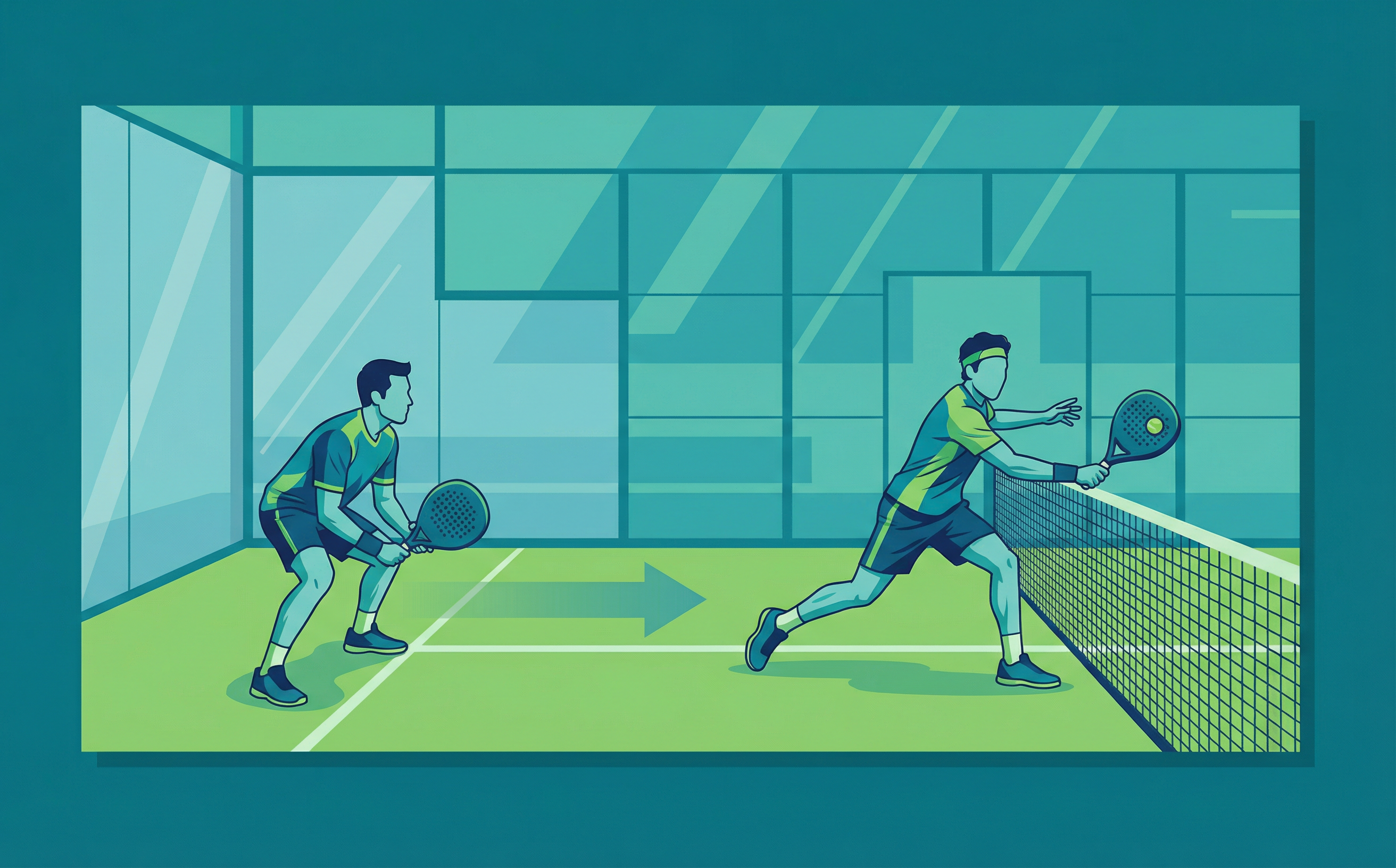
An advanced player never moves alone. The rule is simple: you mirror your partner's movements. They move to the net → you move to the net. They retreat → you retreat. This block play prevents opponents from finding gaps between you and is one of the first things coaches correct when players want to move up.
Quick drill: in your next few matches, focus only on repositioning. Ignore the score — focus on one rule: always return to 1 m from the glass after every shot.
2.Revolutionising Your Defence: Legs Before Arms
The technique myth
Intermediate players try to improve their racket technique to defend better. This is a priority mistake. In defence, 90% of the work is done with the legs (placement, movement, anticipation) and only 10% with the racket (a short, flat push).
The backswing in defence should be short — 20 to 30 cm maximum, versus 80 cm or more for a tennis-style shot. Once well positioned, the shot comes down to a firm push, flat ball, contact in front of the body.
The lob: your most valuable weapon
The lob is the most strategic shot in padel. It lets you reclaim the net, rebalance the point, and put pressure on opponents who have taken the initiative. An advanced player doesn't lob under pressure — they lob on easy balls to guarantee maximum depth (2 to 3 metres above the opponents, aimed at the back of the court).
National federations and coaching organisations point out that the lob is the most under-used shot by amateur players. Those who master it consistently move up the rankings.
Making friends with the glass
Stop running from the glass. If the ball bounces behind the baseline, let it pass and play it on the way out. Touch the side glass with the tip of your racket to calibrate your distance and anticipate the bounce. This skill takes only a few focused training sessions to develop, and it transforms your defence.
Analyse your defence with AI
PadelIQ spots your positioning errors and suggests personalised drills after each match.
Try for free3.Dominating the Net: Control and Centre Coverage
The 50% power rule
At the net, most intermediate players hit too hard. The result: the ball bounces high, opponents have time to reposition and lob easily. The advanced rule is simple: cut the power of your volleys and smashes in half. You gain precision, create shorter bounces, and force opponents into harder balls.
Low volleys: play short, not long
If you receive a ball at your feet at the net, don't try to play it long or cross-court. That's the intermediate reflex — looking for the direct winner. The advanced player plays this ball short and softly toward the fence or side glass, preventing the opponent from counter-attacking. Safety over spectacle.
Close the centre
The centre of the court is the most vulnerable zone. If your partner is pulled to their diagonal, shift toward the centre to cover the gap. This is the second element of the mirror effect: when your partner moves out of the central axis, you compensate.
The two key volleys to master
- High volley: ball between chest and shoulder, hit at 50% power with control and placement.
- Low volley: ball below the hip, block toward the fence or side glass, very little power.
4.Advanced Tactics: Playing with the Opponent's Mind
Bandeja or Vibora: choosing the right overhead
The bandeja (defensive overhead with slice) lets you temporise and hold the net without taking risks. The vibora (more aggressive side-spin shot) goes for the winner. Players who level up quickly learn to distinguish the two situations: bandeja when the opposition is well-set, vibora when they are off balance.
Vary to stay unpredictable
If you always hit hard in the same direction, good defenders will adapt and neutralise you effortlessly. The advanced rule: change rhythm and target zone regularly. Alternate slow, high balls (lobs, chiquitas) with sudden accelerations. This variation unsettles opponents and creates openings. Our article on 15 tactical padel patterns develops this approach in detail.
Strategic targeting
In a competitive match, identify the opponent who is least comfortable or most nervous and direct the difficult balls toward them. This strategy puts that player under pressure and frustrates their partner, who receives fewer balls but watches their team lose points. It's a tactical decision — not a personal one — that pros use systematically. Sports psychology confirms that sustained pressure on one opponent weakens communication within the pair.
The goal is not a winner on every shot. The goal is to build the point: create a difficult situation for the opponent, then finish when the opening is real.
5.Serve and Return: The Advanced Player's Commitment
The serve is not an ace
A common mistake at the intermediate level: chasing the ace or the tricky serve at the expense of moving to the net. In padel, the serve has one purpose: reaching the net in a position of strength. Aim at the side glass at moderate speed to give yourself time to advance. A 70% power serve, well placed, followed by a smooth net approach is far more effective than a 100% serve that leaves you pinned at the back.
The aggressive return
Position yourself 50 cm from the side glass to cut the trajectory before the unpredictable glass bounce. Aim for the feet of the server as they advance: low, driven ball. On a fast first serve, block; on a slow second serve, lob. This differentiated return is one of the first things you notice in players who have levelled up. More detail in our guide on defensive positioning in padel.
Film yourself: the objective truth
The most impactful advice for reaching an advanced level: film your matches and analyse them. You'll often discover that you spend far more time in No Man's Land than you thought, that your lob is shallower than you believe, or that you and your partner are never at the same height. Video doesn't lie. Padel video analysis and AI tools like PadelIQ turn that realisation into a concrete action plan. Check our pricing for available plans.
6.4-Week Action Plan
- Week 1: Focus exclusively on repositioning. One rule only: always return to 1 m from the glass after every shot. Film two matches.
- Week 2: Lob work on easy balls. Target: 100% depth on your uncontested lobs.
- Week 3: Power reduction at the net. Play 50% less hard on all high volleys.
- Week 4: Full integration. Test match with one KPI: how many times you reclaim the net after a successful lob.
Structured practice with clear objectives per session produces better results than simply accumulating matches — a finding consistent across sports science literature and federation coaching programmes.
7.Frequently Asked Questions
How long does it take to go from intermediate to advanced in padel? With structured training two to three times a week and active correction of positioning errors, most players notice a clear improvement within 4 to 8 weeks. Video analysis speeds up the process by making errors visible.
What is the most important shot to master to level up? The deep lob. It's the shot that lets you reclaim the net, rebalance the point, and pressure well-positioned opponents. A mastered lob changes everything else in your game.
Should you reduce power to improve at padel? Yes, especially at the net. Hitting at 50% delivers more precision, shorter bounces, and fewer gifts for the opponent. Power comes back naturally once the technique is in place.
What is the mirror effect in padel? You always move at the same height as your partner on the court. They advance → you advance. They retreat → you retreat. This prevents opponents from exploiting the space between you.
How can video analysis help you improve? Film your matches, watch your court positions (especially in defence), identify when you're in No Man's Land, and count your successful lobs. Tools like PadelIQ automate this analysis and give you a personalised report.
8.Ready to Break Through?
Upload your first match to PadelIQ and get a full diagnosis: placement, decision-making, technique, consistency. The AI pinpoints exactly what's keeping you at the intermediate level.
First analysis free, no card required